A Four-Season Cottage Is Not a Summer Cottage With The Heat Turned On
For much of the last century, a cottage was a summer building — opened in May, closed in October, pipes drained on the way out the door. That assumption is quietly disappearing. More of our clients now want a place they can drive to in January, work from through the shoulder seasons, and use as a year-round home rather than a seasonal escape. Remote work made it practical; a shift in how people value these places made it desirable.
A four-season cottage is not a summer cottage with a furnace added. Once a building has to hold heat through a Muskoka February — and survive the stretches when no one is there to catch a problem early — the consequences run all the way down to the foundation. The envelope, the structure, the servicing, the roof, and the way the rooms meet a low winter sun each have to be rethought. What follows is what genuinely changes, and why these are decisions you want to make at the drawing board, not discover in the first cold snap.
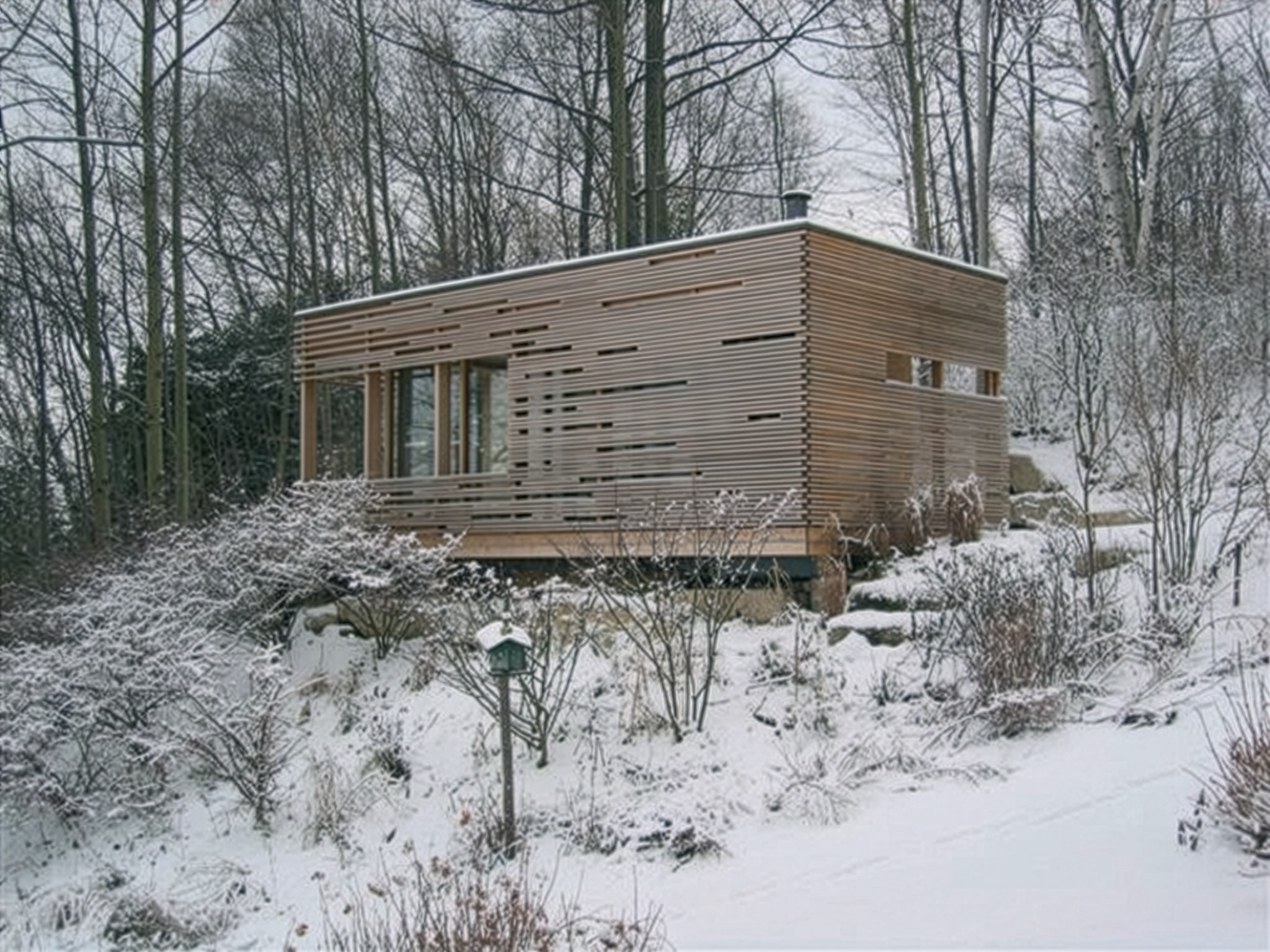
The envelope has to withstand winter, not just survive it
Designing any cottage is already its own discipline, shaped by site and weather in ways urban work isn't. Making one work year-round adds a layer on top of that. A summer cottage's walls have an easy job: keep the rain out and let the building breathe. A four-season envelope has to hold heat against a temperature difference that can exceed forty degrees, while managing moisture trying to move the other way. That changes the wall, the roof, and especially the glazing.
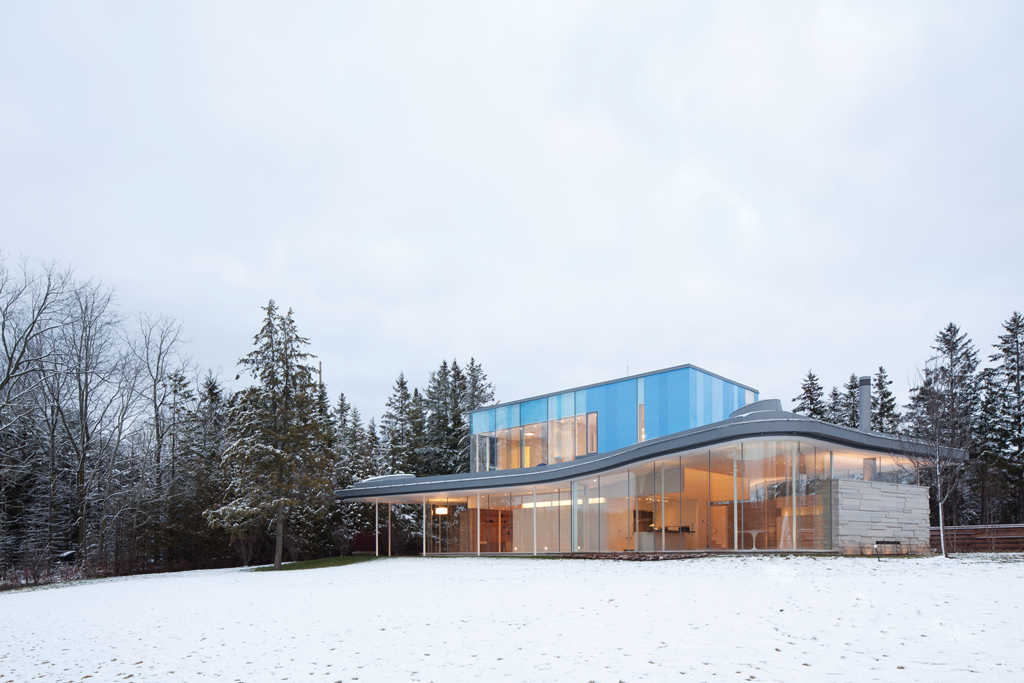
The expanses of glass that make a cottage feel open to the lake become the weak point in winter. Ordinary glazing bleeds heat and sweats with condensation; a year-round cottage wants high-performance windows — triple glazing, warm-edge spacers, thermally broken frames — sized and placed with heat loss in mind, not just the view. Behind the cladding, the harder work is continuity: insulation and a controlled air and vapour barrier carried unbroken across every corner, every window head, and the point where a deck or beam passes through the wall. Get that continuity wrong and you don't just lose heat — you grow moisture problems inside the assembly that stay hidden for years.
Foundations and frost
The foundations that support many summer cottages move with the frost. For a simple seasonal building you can live with a small amount of shifting; for a year-round home with tile, large glazing, and finished interiors, that movement causes cracking. A four-season cottage needs a foundation that ignores frost — footings below the frost line, a frost-protected shallow foundation when building on bedrock, or a full insulated crawlspace or basement.
On much of the Canadian Shield the answer is shaped by rock as much as by frost: you anchor to it and insulate differently than you would on soil. The right solution is site-specific, but the principle isn't — the foundation is the one decision you can't revisit later without enormous cost, so it has to be made for the coldest day, not the warmest.
Servicing that survives a cold snap
Water is the vulnerability. Supply lines have to run below frost or inside heated space, the well and pump arrangement has to be protected, and the whole system has to tolerate the reality that even a four-season cottage sits empty for stretches. The question we work through with every client is what happens during a February power failure when no one is there: a heating system that holds a minimum temperature, freeze-protected mechanicals, drain-down provisions where they make sense, and remote monitoring that tells you something is wrong before a pipe does.
Heating itself usually wants redundancy when you are an hour from the nearest help — a cold-climate heat pump or propane system for the daily load, often with a wood burning fireplace that earns its place as both backup and the emotional centre of a winter cottage. Septic behaves differently under snow and intermittent winter use, too, and is worth designing for rather than assuming.
Snow, roofs, and getting there
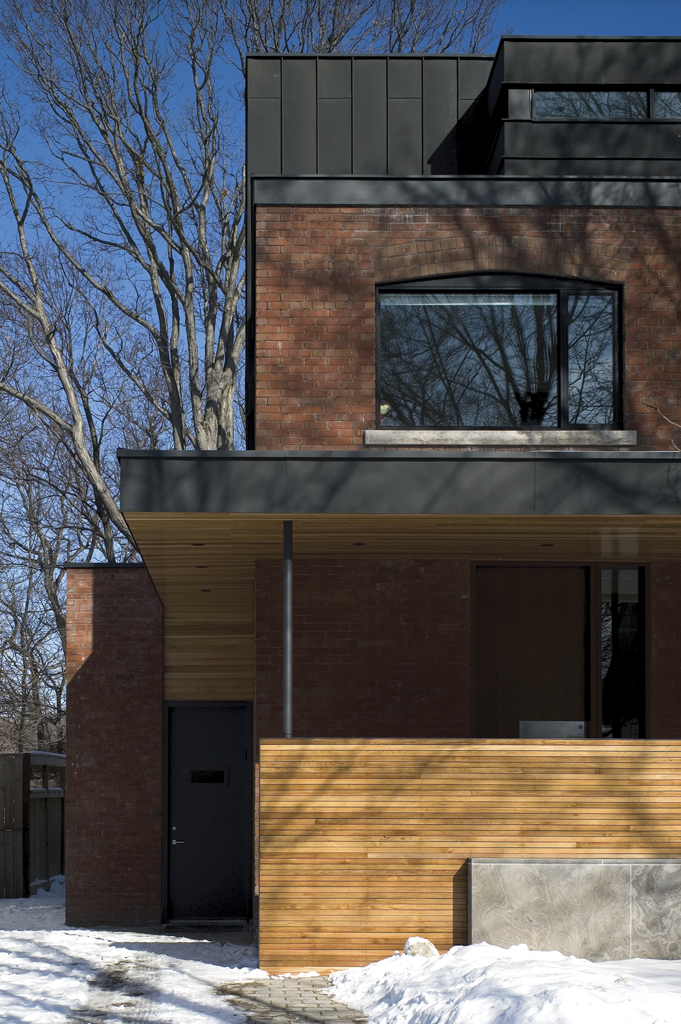
Cottage-country snow loads are heavier than the city's, and the roof structure has to be sized for them. Roof form matters as much as structure: where snow sheds is a design decision, because it should never slide onto the front door, the deck, the heat pump, or the propane tank. Heat escaping at the eaves causes ice dams — which is why the roof and the envelope are really one problem, not two. Where we might have a flat roof for a house in the city, a sloped roof that sheds snow is generally preferable in the country.
Then there is simply getting there. The unplowed road, the long grade of a driveway, where you can park in a storm, and how you reach the door through deep snow are winter design problems, not afterthoughts. A cottage that is a pleasure to arrive at in July can be hostile in January if no one thought about snow until it fell.
Designing for winter light and winter living
Our design philosophy approaches daylight as something to consider across the whole year. The December sun is low and generous if you plan for it — south-facing glass can pull real warmth into the rooms — but the same low angle brings glare, and an overhang placed to shade a deck in July behaves differently in January. These are decisions made in three dimensions early on. And the view itself changes with the seasons: a frozen lake and bare trees are experienced differently than summer greenery. The best four-season cottages are designed for all these opportunities, not only the ones in the iconic photos that you see on the architect’s website.
Contact us for a consultation.
About Michael Taylor Architecture + Design:
Since 2000, Michael and his team have developed an international reputation for creating elegant architecture and interiors in Canada and abroad. Each project is cultivated from the spirit of its location and the distinctive tastes and unique vision of our clients.
Michael Taylor Architecture + Design builds on the legacy of Taylor Smyth Architects and continues its commitment to client service, attention to detail and design excellence.